
Traffic Delays, Please
Quick Thoughts on the Bridge Limit Announcement

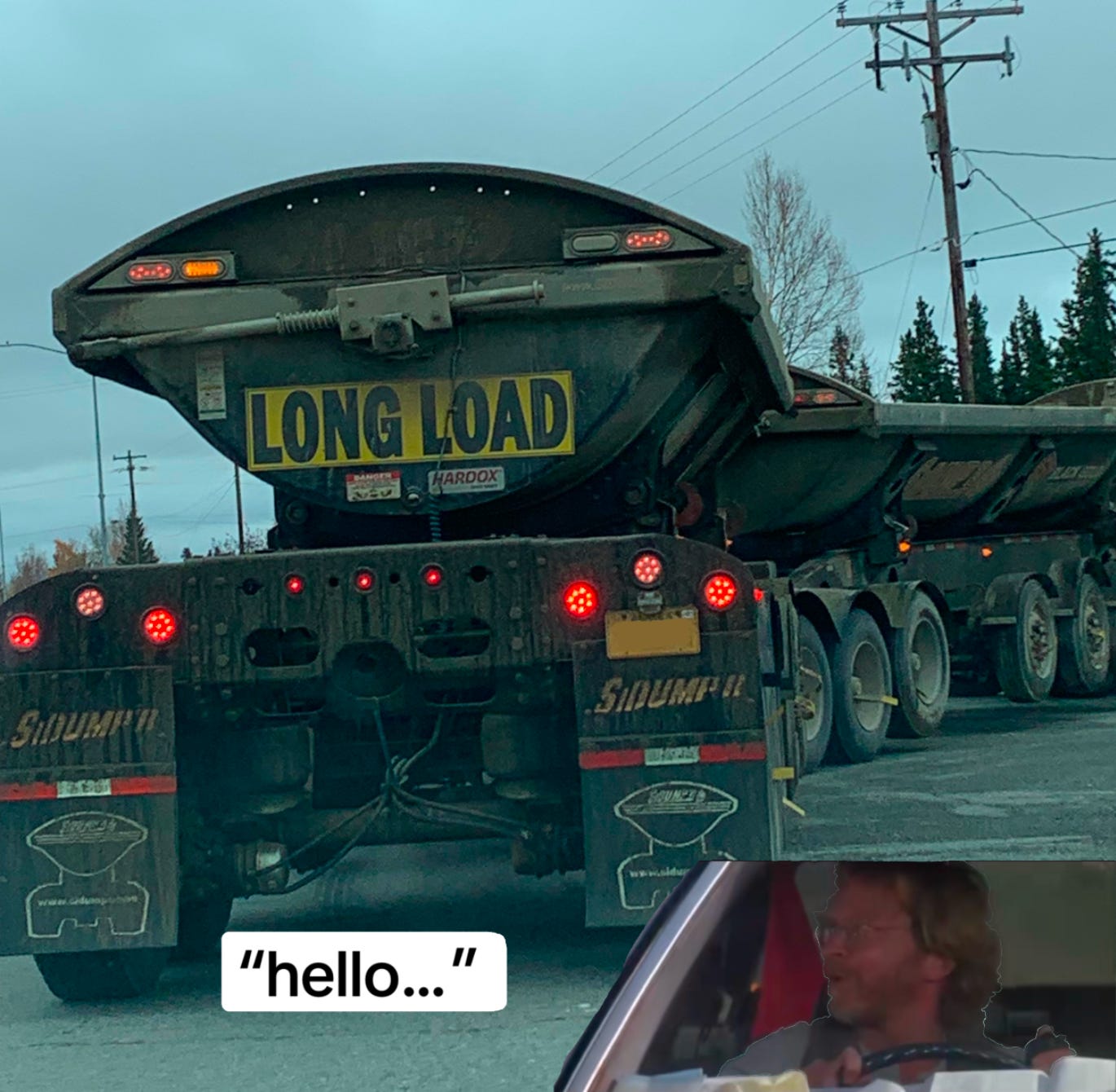
The announcement of a “Load Posting” limit from the Alaska DOT a month ago is vapid fodder shoveled at opponents of the DSO shipping model employed by Rick van Nieuwenhuyse at Contango ORE1 and Toronto-based Kinross at the Manh Choh mine as though it’s supposed to mean something. It is a state government that has actively wanted this project from Day One trying to convince Alaskans that they’re taking action — when in fact, they’ve done nothing.
Here’s the relevant text from the September 3rd announcement:
To protect critical state infrastructure, the Alaska Department of Transportation & Public Facilities (DOT&PF) is implementing a preventative restriction on the following bridges:
Big Delta Bridge (#524) Richardson Highway
Rex Bridge (#216) Parks Highway
Effective immediately, only one Long Combination Vehicle (LCV) will be permitted at a time on either bridge.
This is legalizing traffic delays in the name of feigning concern. The same number of trucks carrying the same amount of ore will run on the same bridges back and forth on our highways. The rest of the road, which is not made of bridges, will also experience the same rest of the strain from the same number of trucks carrying the same amount of ore. Nothing will change, except for one thing — only one truck will be allowed to drive over two bridges — one of which isn’t even on the ore shipping route — at any given time.
This alone raises many questions:
Will truck drivers truly wait for each other to cross a bridge?
What will happen when one Black Gold truck is headed to the Manh Choh site, another is coming from the mine, stacked with 160,000 lbs. of ore, and they pass each other on a bridge?
When multiple, ore-packed Black Gold trucks are rolling down the highway one after another, and they come upon a bridge, will they simply wait to roll across the bridge one at a time — and what will this do for other traffic?
Will commuters be forced to wait as these trucks start and stop?
Why isn’t this limit offered for other bridges — why only these two?
And, will this load limit posting actually be enforced?
It’s suspicious to say the least.
This announcement feels as though it is in service of termed-out governor and Cuckmeister-In-Chief Michael J. Dunleavy’s efforts to paint himself as a political moderate in preparation for his upcoming 2028 senate bid, and to ensure that the governor’s seat remains in Republican hands in 2026. The two most likely candidates to continue his pattern of sheer servitude to outside interests and blatant disrespect towards our state are former Attorney General Treggarick Taylor and former Department of Revenue Commissioner and extraction company tax records concealer Adam Crum, although Dunleavy’s own Lieutenant Governor Nancy Dahlstrom is also running.
Here’s an alternate ask, modeled after Sen. Kawasaki and Rep. Carrick’s mild-mannered SB 218 and its companion, HB 305: actually create and enforce a load limit on industrial trucks.
Kawasaki and Carrick are offering a 140,000 lb. limit on ore haul trucks — 7/8 of the current 160,000 lb. ‘limit’ that has no reliable enforcement mechanism. They’re not even asking that the project be modified in the way that some testifiers requested — to ensure that the ore isn’t transported on Alaskan highways or that an on-site mill be constructed for Manh Choh. The bill was intended to band-aid a problem that was already in the works and seemingly unstoppable — to reduce the strain exerted by these trucks’ constant passage over our roads.
So let’s go with the 140,000 lb. limit. This would need an enforcement mechanism, and punishments for violating our road limits. Importantly, it would need a public record — a catalog — of all weight limits from every ore haul truck that have been weighed.
Consider this the smallest ask — get a tech whiz who can crank out a site in a few hours to design a publicly-viewable link that automatically records the load limit of each truck passing through a weigh station and posts the load limits.
This monitoring is necessary. After all, it’s hard to trust people who don’t see fit to finish public testimony before beginning their massive trucking project.
I drove down to Delta the past couple of weekends with family. The road looked nothing like it used to in October of 2023 when I was last there. Much of the clunky, pothole-ridden, permafrost-rattled asphalt has been replaced and now looks like the built-up stretches outside Denali and Mat-Su, with wide berms on either side, fresh asphalt and a deep drainage ditch.
It’ll look like a mess soon enough. Because the same number of trucks will still be running, with the same amount of ore.
This attempt at pandering to well-founded concerns about safety, the ability to even have public input, how much money our state is actually taking in, and how this will impact quality of life in our region is just that. It’s an attempted distraction from the fact that nothing has changed about the project. When the DSO model was launched and public comment was open, my initial ask of the project was to run the Alaska Railroad down to the mine site, to not put a strain on the roads. I received this response from Anchorage contractor Kinney Engineering:
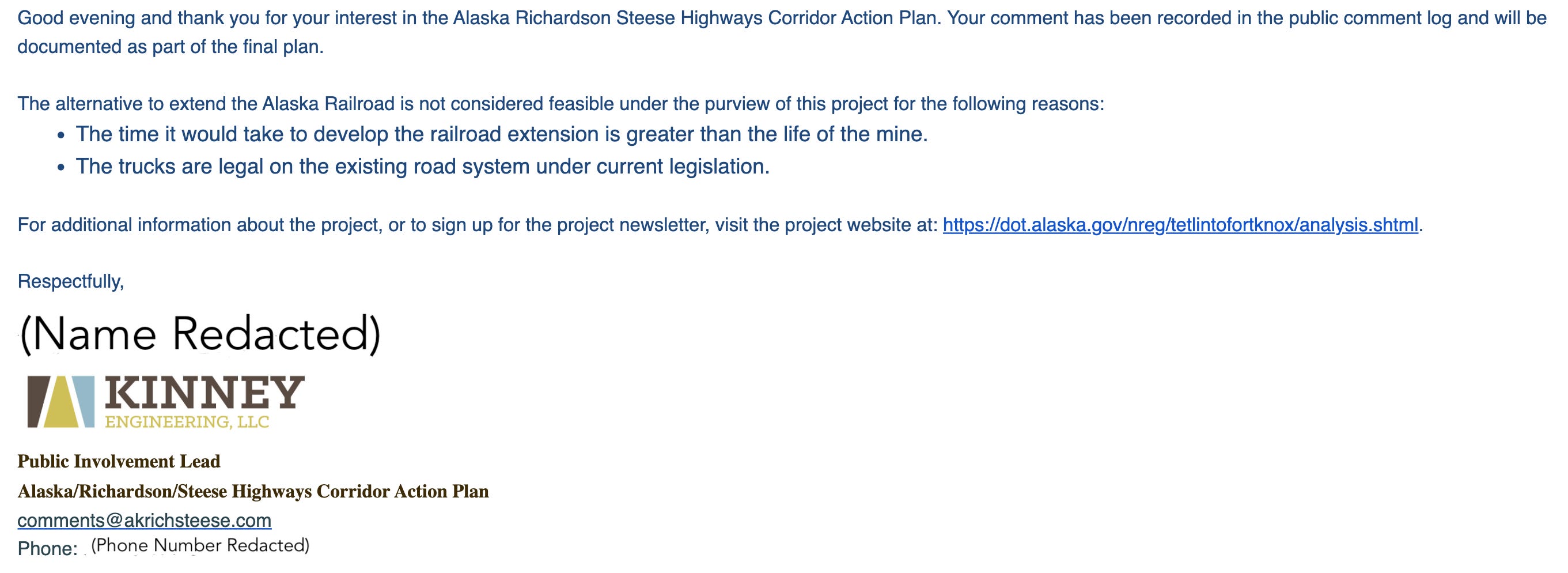
It’s interesting that we would have to consider the life of the mine against the estimated time of getting the mine set up — particularly when safety standards need to be met. It’s a view of those looking to make a quick buck at the expense of those already living there.
To that point, an astounding write-up from Kevin Gunter on the Tetlin Corporation’s website pulls agreements from the history of the mine and shows that Tetlin tribal members were never allowed to vote on this in a way consistent with their by-laws at the same time that they’re restricted from exercising their sovereign rights over their land for the purposes of this mining project.
Tribal sovereignty was forefit in service of extraction interests so that only a few in top leadership positions could profit, while throwing their peoples’ long-held ways of life under the bus.
Gunter’s write-up deserves an even greater spotlight as it shows another way in which outside extractors diligently pit Alaskans against each other by negotiating through a few beneficiaries at the top and letting the rest of us scramble for whatever is left as we attempt to save our resources from their extraction.
The financials that have come from the project are dire, too. Advocates for Safe Alaska Highways pulled the numbers from Kinney Engineering’s report and showed that the government will be paying an estimated $1.04 billion in road repairs — while Alaska takes in no revenue in tax. A report from McKinney engineering found that taxation contributed just $136 million to our state’s revenue coffers in 2022.
While the railroad extension would have been nearly $800 million more than the $1.04 billion we’re paying, consider the fact that Toronto-based Kinross and recently-relocated Contango would’ve had to scrap together $500 million for an on-site mill to process their gold. That brings the total amount of money that could’ve potentially been invested in this project to $1.54 billion, $260 million short of the $1.8 billion estimate for extending the railroad. (We could consider using tax underpayments from oil and gas extraction companies to cover the rest of the cost, but our current governor’s administration seems adamant to conceal that data and stymie any resolution on this.) And, unlike the current ore haul, where economic benefits are limited to the outside extraction companies and the costs and damages are born exclusively by the state, it would have benefits.
The benefits range from expanded tourism routes to better transportation for other economic sectors. The route would run through the Delta area, an agricultural region that deserves better investment and has been promised the railroad extension for decades. This could allow for expanded transportation in agricultural products from the region, including barley and dairy products.2 This would enable us to grow our local agricultural sector and increase food security after decades of decline in that sector.
In other words, it’s a project that, over time, would return on investment.
Alaska is not getting money from enabling the DSO model, we’ll be spending even more, and our state will have no tax revenue from this project. We should have no patience for their feigned concern. Our state deserves better, particularly when there are better options available that would allow us to grow our own local economy. If we’re not going to fix our relationship to our resources and take in revenue from what we extract beneath our soil, then at least transport them it in a way that does the least harm.
You have to wonder what the Q3 earnings report from Contango will sound like! It’ll be fascinating to see how much money they’re making off our state’s back.
Anyone else remember picking up Northern Lights Dairy’s milk at the store? It was fresh and lasted longer than the generic Fred Meyer’s brand or Safeway brand milk. I hope to see it make a return and, eventually, out-pace the generic storebrand offerings.